Trying to decide between sapele vs mahogany for your next order? It is one of the questions we hear most from furniture factories, door makers and importers. Both woods are reddish-brown, both belong to the same botanical family, and both are sold as “mahogany” in some markets. Yet they behave differently in the workshop, they carry different paperwork, and they do not cost the same per cubic metre.
In this guide we compare the two side by side, with real figures, so you can pick the right one for your product and your budget. We supply both from Central Africa at Global Timber Trade Hub, so we see every week where each one works best.
In short
- Sapele is harder and heavier than both African and genuine mahogany.
- Mahogany is easier to machine, carve and finish.
- Sapele shows a strong ribbon stripe; mahogany looks calmer.
- African mahogany (Khaya) and genuine mahogany need a CITES permit; sapele does not.
- Sapele usually costs less per m³ than Khaya.
- For flooring and high-wear furniture, choose sapele. For carving and boats, choose mahogany.
What we mean by “mahogany”
The word mahogany covers more than one timber, and this causes a lot of confusion in quotes and contracts. Before comparing, it helps to be precise:
- Genuine mahogany (Swietenia macrophylla), also called Honduran or big-leaf mahogany, from Central and South America.
- African mahogany (Khaya species), from West and Central Africa. This is the mahogany most buyers can actually source in volume today.
- Sapele (Entandrophragma cylindricum), a close cousin in the same family, Meliaceae, often sold as a mahogany alternative.
When buyers ask us about sapele vs mahogany, they usually mean sapele vs African mahogany, because genuine mahogany is now scarce and heavily regulated. We cover both comparisons below.
Sapele vs mahogany at a glance
| Property | Sapele | African mahogany (Khaya) | Genuine mahogany |
|---|---|---|---|
| Density at 12% MC | 640–670 kg/m³ | 500–560 kg/m³ | about 590 kg/m³ |
| Janka hardness | about 1,410 lbf | about 1,070 lbf | about 800–900 lbf |
| Natural durability | Moderately durable | Moderately durable | Durable |
| Stability | Medium movement | Small to medium | Very stable |
| Figure | Strong ribbon stripe | Mild stripe, sometimes mottled | Even, sometimes figured |
| CITES | Not listed | Appendix II | Appendix II |
Figures are typical values. Individual logs vary, which is why we always send moisture readings and photos before loading.
Hardness and wear: sapele wins
This is the clearest difference. Sapele is around a third harder than African mahogany. In practice, that means fewer dents in tabletops, stair treads and flooring. If the finished product will be walked on, leaned on or knocked by chairs every day, sapele is the safer choice.
Mahogany is softer. That is not a defect. It is part of why carvers and boat builders love it, but it does mean a mahogany floor will show wear sooner.
Stability: mahogany has the edge
Genuine mahogany is famous for staying put once it is dry. African mahogany is close behind. Sapele moves a little more with changes in humidity, so it needs proper kiln drying and a few days to settle in your workshop before final machining.
For most furniture and doors this difference is small, as long as the timber is dried to the right level. We kiln dry joinery grades of sapele to 10–12% moisture content, or lower on request, and that is what keeps it flat.
Appearance: stripe or calm grain?
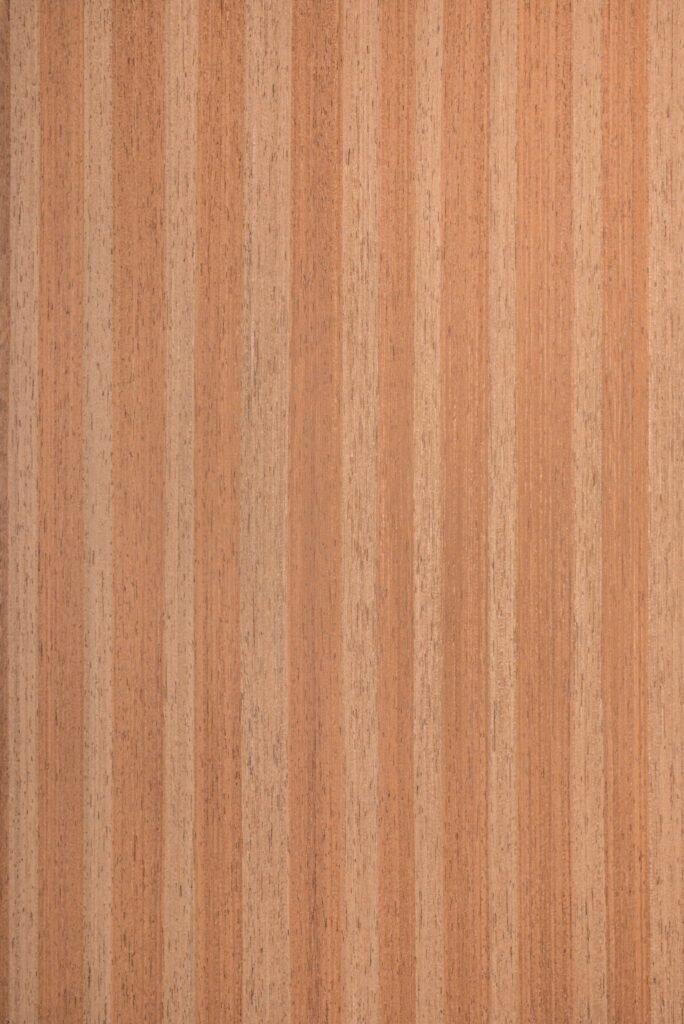
Quartersawn sapele shows a bold ribbon stripe that shimmers as the light moves. Some customers buy sapele precisely for that look, for cabinet doors, guitar backs and veneer. Others find it too busy for large plain surfaces.
Mahogany looks quieter. The colour is warm pinkish to reddish-brown, the grain is more even, and the figure is softer. It suits classic furniture, panelled rooms and traditional joinery.
Both darken with time and light. Within a year or two, the colour difference between them becomes smaller than most people expect.
Workability in the workshop
Machining sapele
Sapele has interlocked grain. On a planer it can tear out if your knives are dull or your cutting angle is high. A helical cutterhead, sharp tooling and light final passes solve most of this. It glues well and takes stain and lacquer evenly.
Machining mahogany
Mahogany is one of the easiest hardwoods to work. It cuts, carves, sands and turns cleanly, and it holds fine detail. That is why it remains the first choice for carved furniture and decorative mouldings.
Sapele vs mahogany for outdoor use
Neither is a first-choice decking timber. Both are rated moderately durable, so they perform well in exterior doors and windows when finished and maintained, but not in ground contact.
If your project is outdoors and exposed, look at very durable species instead, such as Iroko, Padouk or Doussie.
CITES rules: the difference that affects your paperwork
This is the point many buyers miss. Since 2023, African populations of Khaya are listed in CITES Appendix II, and genuine mahogany has been listed since 2003. That means every export needs a CITES permit, and your import must match it.
Sapele is not listed under CITES. It still needs legal-origin documents, a phytosanitary certificate and a certificate of origin, but there is no CITES step. For buyers who want a simpler import, that alone can decide the sapele vs mahogany question. You can read more on our sustainability and legality page.
Price per cubic metre
Prices change with grade, thickness, drying and volume, so treat these as starting points. On our site the indicative starting price is:
- Sapele: from $850 per m³
- African mahogany: from $950 per m³
Genuine mahogany is rarely available in container volumes today, and when it is, it costs far more. For most commercial buyers, the real choice is between sapele and Khaya, and sapele is usually the more economical of the two.
Which one should you buy?
Choose sapele if you need
- flooring, stair treads or worktops that take heavy wear;
- a striking ribbon figure for doors, panels or instruments;
- long, wide, clear boards at a good price;
- a simpler import with no CITES permit.
Choose African mahogany if you need
- carving, turning or fine mouldings;
- boat interiors and light marine joinery;
- the classic, calm mahogany look for traditional furniture;
- a lighter board that is easy to handle.
What about Sipo and Kossipo?
Two other members of the same family often enter the conversation. Sipo (Utile) looks like a calmer sapele and moves less, which makes it popular with European window makers. Kossipo is slightly darker and coarser and is usually the cheapest of the group. If neither sapele nor mahogany fits perfectly, one of these often does.
A typical buying scenario
Here is how this choice often plays out. A door manufacturer wants a mahogany look for an export range. Khaya would be the traditional answer, but the CITES permit adds time to every shipment. By switching the solid frames to kiln-dried sapele and keeping a mahogany-type stain, they get the same colour family, a harder surface and a simpler import, at a lower cost per m³.
Another buyer makes carved reproduction furniture. For them, sapele’s interlocked grain would mean more sanding and rejects. African mahogany is worth the extra cost and the extra paperwork.
How to order either species
Ordering is the same for both:
- Send species, thickness, width, length, grade and volume.
- We reply with price per m³, stock photos and lead time.
- Timber is cut, dried, inspected and photographed before loading.
- You receive the full set of export documents with the bill of lading.
The full process is explained on our export process page.
Finishing sapele and mahogany
Both woods finish beautifully, but they ask for slightly different care.
Sapele has an open, medium texture. If you want a mirror-gloss piano finish on furniture, fill the grain first. A water-based filler tinted slightly darker than the wood works well. On doors and windows, a microporous exterior coating lets the wood breathe and reduces checking.
Mahogany takes stain very evenly, which is one reason it became the classic furniture wood. Oils, shellac and lacquers all give good results. Because it is softer, avoid very hard, brittle film finishes on surfaces that will be knocked often.
A practical tip from our buyers: if you mix the two woods in one product, for example a sapele frame with mahogany carved details, stain a test panel of each first. They take colour slightly differently, and a test saves a lot of rework.
Grades and how to specify your order
Price comparisons only make sense when the grade is the same. For export sawn timber, the most common grades are:
- FAS (First and Seconds): long, wide, mostly clear boards for furniture and joinery;
- FAS 1F: one face FAS, the other slightly lower, often a good value choice;
- Common grades: shorter clear cuttings, fine for components and cut-to-size parts.
When you ask for a quote, give us the grade, thickness, minimum width, length range and moisture content. With that, we can price sapele and mahogany on exactly the same basis, and you will see the real difference.
Common mistakes when comparing sapele vs mahogany
- Comparing different grades: FAS sapele against a lower mahogany grade is not a fair price comparison.
- Ignoring moisture content: air-dried and kiln-dried prices are not the same product.
- Forgetting the CITES step: plan an extra few days for Khaya documents.
- Judging colour on fresh boards: both woods change colour in the first months.
Sources
- CITES Checklist for the current listing of Khaya and Swietenia.
- CIRAD Tropix for technical data on tropical timbers.
- Entandrophragma cylindricum on Wikipedia for background on sapele.
Related guides
- Buy African sapele wood
- Buy African mahogany wood
- Iroko vs teak
- African hardwood prices per m³
- Furniture and joinery hardwoods
Frequently asked questions about sapele vs mahogany
Is sapele a real mahogany?
Sapele belongs to the mahogany family, Meliaceae, but it is a different species from both genuine and African mahogany. It is widely sold as a mahogany alternative.
Is sapele harder than mahogany?
Yes. Sapele is around 1,410 lbf on the Janka scale, against roughly 1,070 lbf for African mahogany and less for genuine mahogany.
Which is cheaper, sapele or mahogany?
Sapele is usually cheaper per m³ than African mahogany, and much cheaper than genuine mahogany when that is available at all.
Do I need a CITES permit for sapele?
No. Sapele is not CITES listed. African mahogany is, so Khaya shipments always travel with a CITES export permit.
Get a quote for sapele or mahogany
Still not sure which one fits? Send us your project and cutting list through our quote form. We will tell you honestly which species works best and what it will cost delivered to your port.