Tali has become one of the most popular African hardwoods for decks, boardwalks, sleepers and heavy outdoor construction. It is dense, very durable, strong and available in good volumes, and its warm reddish-brown colour looks good on terraces and walkways. For many deck builders and contractors, it offers the durability of famous heavy timbers at a far friendlier cost. In this guide we explain the tali wood price in detail, so you can budget accurately and compare quotes fairly.
We cover typical FOB prices for the main tali products, how drying, profiling and size affect cost, how to convert to a price per square metre for decking, why weight matters for freight, and practical ways to get better value. Prices are indicative starting points from our own quotes at Global Timber Trade Hub, where we supply tali sawn in Cameroon, Gabon and the Republic of Congo.
In short
- Sawn tali starts from about $650 per m³ FOB for standard sections.
- Kiln-dried, profiled decking costs from about $850 per m³ FOB.
- A 21 mm tali deck works out at roughly $19–24 per m² FOB in board value.
- Tali is heavy, so containers are limited by weight rather than space.
- It is not CITES listed, which keeps paperwork and lead times simple.
- It is one of the best-value very durable decking timbers available.
Typical tali prices
| Product | Typical spec | Indicative price (USD, FOB) |
|---|---|---|
| Sawn boards and sections | Air dried or fresh sawn, standard sizes | from $650 per m³ |
| Decking boards, KD | 21–28 × 120–145 mm, smooth or ribbed | from about $850 per m³ |
| Beams and posts | 100 × 100 mm to 200 × 300 mm | from about $750 per m³ |
| Railway sleepers | Standard sleeper sizes | from about $700 per m³ |
| Joists for decking | 45 × 70 mm and similar, air dried | from about $700 per m³ |
These are starting points that depend on exact specification, volume and stock. For other species, see our African hardwood prices guide.
What is tali?
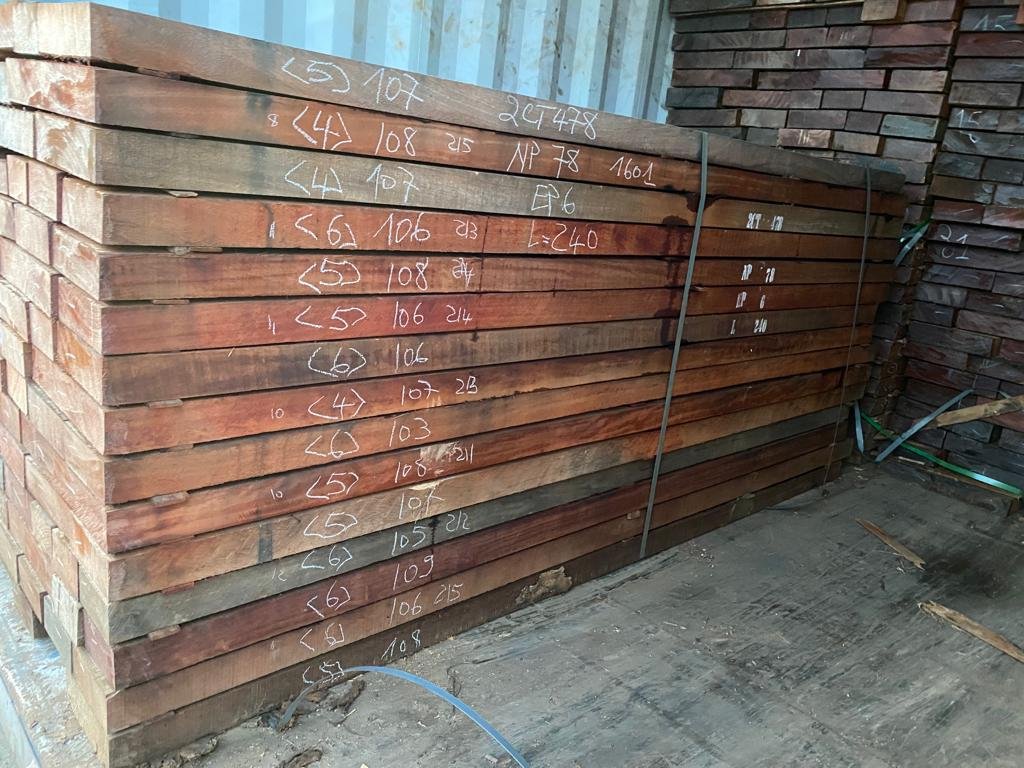
Tali comes from Erythrophleum ivorense and Erythrophleum suaveolens, large trees found across West and Central Africa. The heartwood is yellow-brown when freshly cut and darkens to a reddish-brown, with some natural colour variation between boards. It is dense, around 900–950 kg per cubic metre when dry, with interlocked grain and very high natural durability in ground and water contact. It is used for decking, sleepers, bridges, marine works, industrial floors and heavy joinery. Read more in our tali wood guide.
Why tali offers good value
Tali is widely distributed and harvested in good volumes, so supply is steadier than for rarer heavy hardwoods. It is not CITES listed, so there are no permit delays. Its logs are large and straight, which gives good yield of long boards and beams. And it delivers durability and strength suitable for public boardwalks and railway lines. That combination keeps its price moderate while its performance is high, which is why it has grown in popularity as an alternative to ipe and other expensive decking species.
Decking price per square metre
Most decking buyers work in square metres. For 21 × 145 mm boards laid with gaps of about 5 mm, one cubic metre of boards covers roughly 40–45 m² after allowing for cutting waste. At about $850–950 per m³ FOB for kiln-dried, profiled decking, the board cost is around $19–24 per m² FOB. For thicker 28 mm commercial decking, coverage falls to around 30–33 m² per cubic metre, so the cost per square metre rises accordingly. Then add joists, fixings, freight, duties and installation. Our hardwood decking cost guide shows complete examples.
What pushes the price up
- Kiln drying: dense tali needs slow drying, adding time and energy cost.
- Profiling and planing: machined decking and planed beams cost more than rough sawn.
- Fixed lengths: exact lengths create more waste at the mill.
- Large or long sections: beams over 6 m and big cross-sections need selected logs.
- Colour sorting: selecting boards for even colour adds labour.
What brings it down
- Random lengths and standard profiles.
- Air-dried stock for joists, posts and outdoor structures.
- Full container orders rather than small parcels.
- Flexible delivery dates that fit normal mill production.
Weight and freight
Tali is heavy. A 20 ft container usually reaches its weight limit at around 18–22 m³ of tali, depending on moisture content and the shipping line’s limits. That means freight per cubic metre is higher than for lighter woods such as sapele or ayous. Kiln-dried decking weighs less than fresh-sawn timber, so more fits per container. Mixing tali with lighter species, or using 40 ft containers where road weight limits allow, can lower freight per cubic metre. See how much timber fits in a 40 ft container and timber shipping cost.
How tali compares on price
| Species | From (USD/m³, FOB) | Best for |
|---|---|---|
| Tali | $650 | Decking, sleepers, boardwalks |
| Okan | $650 | Decking, heavy structures |
| Azobe | $650 | Marine works, heaviest loads |
| Iroko | $950 | Furniture, cladding, stable decks |
| Doussie | $1,350 | Premium pool and yacht decks |
Tali is often the first choice for decks among the dense species because it profiles more easily than azobe and has an attractive warm colour. Read our tali vs azobe comparison for details.
Tali compared with composite and softwood
Buyers often weigh tali against composite or treated softwood decking. Tali costs more than budget composite and treated pine, but often about the same as premium capped composite. It stays cooler in the sun, is much stiffer, can be sanded and refreshed, and typically lasts longer than treated softwood. See our hardwood vs composite decking and hardwood vs softwood decking guides.
How tali performs over the years
A well-installed tali deck with good airflow underneath can last for decades. The reddish-brown colour weathers to silver-grey if left unoiled, and the dense surface resists dents from furniture and heavy traffic. Like most dense hardwoods, tali can show small surface checks as it weathers, especially in strong sun; these are normal and rarely affect performance. Occasional oiling keeps the colour richer and reduces checking. Because tali needs so little maintenance and lasts so long, its cost per year of service is often lower than cheaper materials that need replacing sooner.
Working costs
Tali is hard and dense, so use carbide-tipped blades, pre-drill every screw hole and use stainless steel fixings. Installation takes longer than with softwood. Tali dust can irritate the skin and airways, so use extraction and wear a mask when cutting large amounts. Include these working costs in your budget alongside the timber price.
From FOB to landed cost
Our prices are FOB at a Central African port. To estimate your landed cost, add sea freight, insurance, destination port charges, customs clearance, any duties and taxes, and delivery to site. For heavy timber, these costs can add 20–35% to the FOB value depending on the route. We are happy to quote CIF to your port so you can compare directly. See FOB vs CIF timber.
Legal status
Tali is not CITES listed. Buyers in the EU must meet due diligence and EU deforestation regulation requirements, and US buyers must comply with the Lacey Act. We provide documents showing legal origin with each shipment. See our sustainability page.
Lead times
Air-dried sections are usually ready to load in 4–6 weeks. Kiln-dried profiled decking takes about 6–10 weeks depending on volume. For spring and summer decking seasons in Europe and North America, order in winter.
A worked budget for a tali deck
Let us look at a simple example to show how the numbers come together. Suppose a landscaping company is building a 60 square metre terrace with 21 × 145 mm tali boards on tali joists. The deck boards need about 1.4 to 1.5 cubic metres of kiln-dried decking once waste is allowed for. The joists, at 45 × 70 mm spaced about 450 mm apart, need roughly half a cubic metre of air-dried tali. At typical starting prices, the timber for the whole deck comes to somewhere around ,600 to ,800 FOB. On top of that, the company will pay its share of freight if the timber arrives in a mixed container, plus duties, stainless fixings and labour. Even after those costs, the timber is often a smaller share of the final price than the installation itself. That is why it rarely pays to save a little on the boards and then replace the deck years earlier than planned.
Buying for several projects
Deck builders and distributors who order a full container of tali at a time get the best price per cubic metre and can cover several jobs from one shipment. A typical mixed load might include kiln-dried decking boards in two widths, air-dried joists and a few beams for steps and frames. Store the timber flat, stickered and covered until use. We can help you plan a container that matches your season’s work.
Common mistakes
- Forgetting weight limits: you will ship less volume than you expect.
- Not pre-drilling: screws snap and boards split.
- No ventilation under the deck: boards cup and decay faster.
- Comparing FOB with CIF quotes: compare like for like.
Our honest advice
Tali is one of the best-value very durable hardwoods for decks, boardwalks, sleepers and outdoor structures. Order kiln-dried profiled boards for decks, air-dried sections for structures, plan containers around weight, and compare landed costs. If you need maximum stability for a pool deck or yacht, step up to doussie; for most other outdoor work, tali delivers excellent results at a fair price.
Sources
- The Wood Database for tali properties.
- USDA Forest Products Laboratory, Wood Handbook
Related guides
Frequently asked questions about tali wood price
How much does tali cost per cubic metre?
Standard sawn tali starts from about $650 per m³ FOB; kiln-dried decking from about $850.
How much is tali decking per square metre?
Roughly $19–24 per m² FOB in board value for 21 mm boards, before freight and installation.
Is tali cheaper than ipe?
Usually yes, and it is not CITES listed, so supply and paperwork are simpler.
How long does a tali deck last?
With good ventilation and installation, often several decades.
Get a tali price
Send us your board sizes, profile, deck area or volume and destination through our quote form. We will reply with a firm price and lead time.